















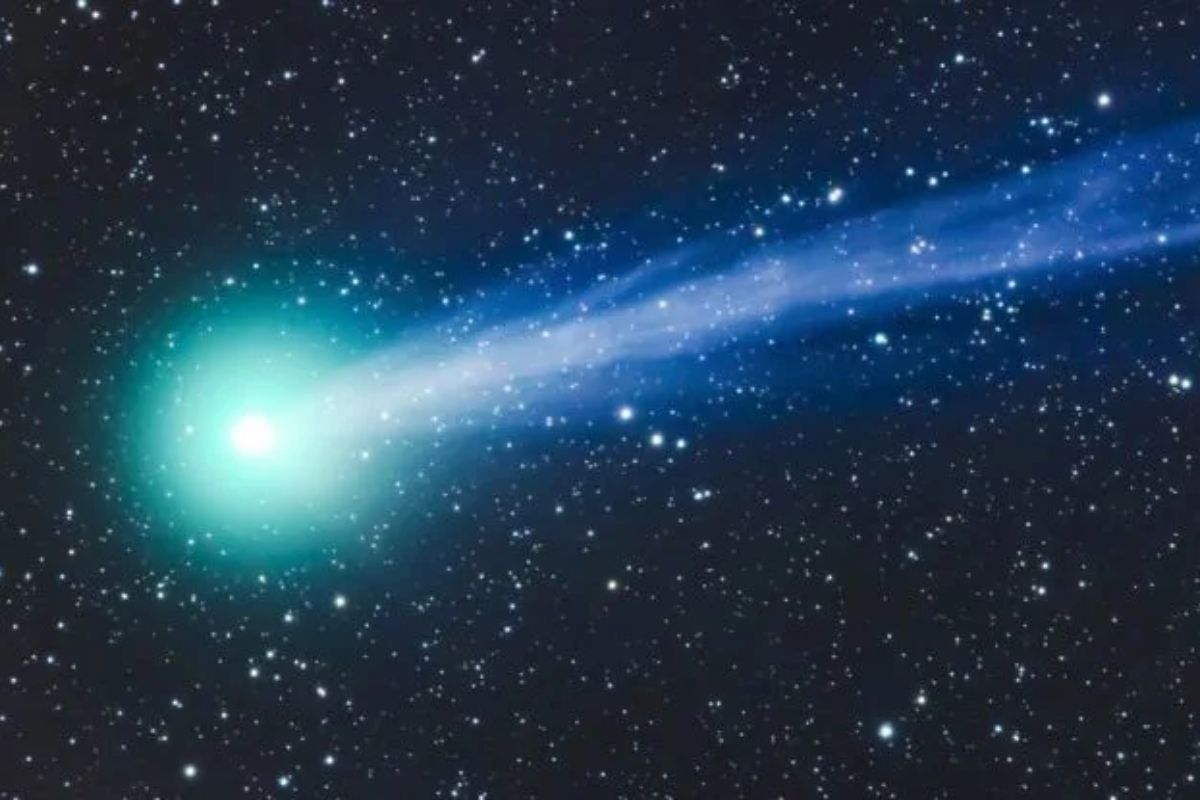
A strange visitor from space called 3I/ATLAS is the latest object to get astronomers all over the world excited and interested. The object was found in July 2025 and has been acting in such a strange way that NASA and the International Asteroid Warning Network (IAWN) are closely watching its moves. It was found that 3I/ATLAS is the third known interstellar object to pass through our solar system. This has led to a lot of questions about where it came from, what it is made of, and why it is acting differently than other comets.
Its name comes from the Asteroid Terrestrial-impact Last Alert System (ATLAS) camera in Hawaii, which was the first to notice it. The object is now officially known as 3I/ATLAS. Since then, scientists have seen changes in the comet’s brightness and speed that make them think it might not behave like any other known space rock or body in the interstellar medium. Scientists from the world’s best telescopes and space agencies have been working hard to get as much information as they can about it before it continues its journey out of our solar system.
Astronomers think that 3I/ATLAS will be closest to Earth on October 29 or October 30. This will be a very rare chance to study something from outside our solar system. The comet’s trajectory indicates that it is travelling at a high speed, which is typical of interstellar visitors from distant star systems. Comets orbit the Sun, while interstellar objects, such as 3I/ATLAS, enter our solar system from deep space. They move in hyperbolic paths that make it look like they were once part of other planetary systems.
NASA says there is no chance of an impact, but experts are interested in the comet’s strange signals and changing brightness. The comet may contain substances never found in a comet before, according to some researchers, while others believe the changes could be due to volatile molecules evaporating from the comet’s surface as it approaches the sun. The comet may potentially provide information regarding the flow of organic compounds and materials across star systems, according to scientists. This is a crucial question for comprehending the evolution of the cosmos and maybe the origin of life.
The fact that 3I/ATLAS is the third cosmic object ever recorded makes it even more interesting. The first one, called 1I/‘Oumuamua, was found in 2017 and widely confused astronomers with its cigar-like shape and fast speed. The second, 2I/Borisov, which was found in 2019, looked more like a comet. It had a clear tail and a makeup that fit with bodies made of ice. Right now, 3I/ATLAS seems to do a mix of the two, which makes experts not sure what it really is. Some experts have even called it “the cosmic chameleon,” which they think is funny.
A number of astronomical sites and space agencies have released live tracking tools and real-time visualisations of 3I/ATLAS to keep people interested and up to date. Fans of space can now track the comet’s path using “The Sky,” a website that gives users up-to-date locations, brightness data, and telescope feeds. NASA and the European Space Agency (ESA) are also streaming live updates of the comet’s approach, along with 3D simulations of its path and comments from experts.
Thousands of people are watching the live tracking of 3I/ATLAS on the internet, and it’s become a big deal. There is a lot of talk, discussion, and beautiful pictures taken by amateur astronomers around the world on social media sites. Some users have said that it looks like something from science fiction, and they think that interstellar objects like this could be pieces of faraway planet systems or even the remains of stars that have been dead for a long time. Theories like these are still just guesses, but they show how interesting and mysterious it is when things come into our universe from nowhere.
Scientists are looking at the comet’s makeup right now using information from ground-based stations in Chile and Hawaii as well as the Hubble Space Telescope and the James Webb Space Telescope. According to early data, 3I/ATLAS may have a lot of metallic and carbon-based compounds, which could help scientists figure out where it came from. The finding also supports the idea that dust, gas, and rocky matter naturally travel between stars as part of the galaxy’s life cycle.
Scientists expect to get additional insight about interstellar bodies and their role in the universe as 3I/ATLAS approaches Earth. Each discovery of a galactic visitor adds a new piece to the cosmic puzzle that demonstrates the complexity and diversity of the objects that exist outside of our solar system. Whether 3I/ATLAS behaves more like an asteroid, comet, or something else entirely is unknown, but one thing is certain: it has reignited global curiosity in what is out there.
At the moment, people can keep watching history being made by going online and checking the 3I/ATLAS live tracking reports. As scientists continue to look at it, people around the world are waiting for this mysterious visitor from another star system to reveal new information about how we got here in the universe.